


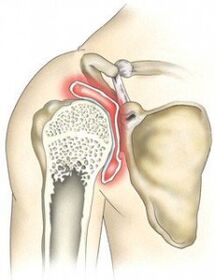
Shoulder arthrosis is a chronic pathology in which the articular cartilage and adjacent bone tissue are degraded, worn and destroyed.If you treat this disease carelessly and do not start treatment in time, the consequences can be quite catastrophic, including loss of motor functions of the hand.
Why does shoulder arthrosis develop?
The impetus for the development of shoulder arthrosis is inflammation in the joint.It can appear for various reasons:
- Injuries.Osteoarthritis of the shoulder can develop due to previous trauma to the shoulder or permanent mild microtrauma to the shoulder, typical of athletes.
- Vascular diseases.In vascular pathologies, blood circulation is usually impaired, which leads to insufficient blood supply to the joints.As a result, joint tissues undergo degenerative changes, i.e.arthrosis develops.
- Excessive load.This is often associated with the work activity of the patients (loaders, construction workers).
- Hormonal or autoimmune disorders.Often they significantly affect joint tissues, having a destructive effect on them.These are diseases such as psoriasis, gout, etc.
- Heredity.It has been proven that children of parents with arthrosis of the shoulder joint are more likely to develop joint defects than the others.This also includes people who are already born with any joint defects.Both of them perceive the usual load on their hands as excessive, and therefore the process of cartilage wear proceeds much faster.
- Failures in metabolic processes and the endocrine system.Because of this, salts begin to accumulate in the joints, and cartilage tissues stop receiving proper nutrition (phosphorus, calcium, etc.) and begin to deteriorate.
- Diseases of the joints.A prerequisite for the development of arthrosis can be joint pathologies such as arthritis, bone necrosis, synovitis, etc.
- Age.Elderly people (50 years and older) are especially at risk, as joint tissues wear out with age, which in itself leads to the development of pathology.
Signs of arthrosis of the shoulder
Arthrosis is characterized by a long development, sometimes it does not manifest itself in any way in the initial stages.That is why you should be very careful with the smallest symptomatic manifestations.Osteoarthritis of the shoulder is usually indicated by:
- Pain is considered the main symptom of the disease.Aching pain often bothers patients in the morning.Pain syndromes are also more possible with sudden changes in weather.If you subject your sore shoulder to some load, for example, lifting something heavy, then the pain will also remind you of itself.The patient feels pain even when palpating the shoulder.With the development of shoulder arthrosis, pain begins to appear even in a quiet position.This fact should be taken into account - with arthrosis of the shoulder joint, the pain can appear not only in the affected joint, it can be localized in the hand, elbow or back.
- Motor dysfunction.Because of the pain, it becomes difficult for the patient to cope with seemingly simple tasks, for example, combing the hair.By the way, this action is one of the test movements for diagnosing arthrosis.Rotational movements and attempts to move the arm backwards are also difficult.If the treatment is not started in time, gradually the shoulder joint and, accordingly, the arm stop moving completely and a contracture develops.
- Painful crunching, grinding in the joint.It usually occurs due to deposition of salts in the diseased joint (osteophytes).Initially, a weak, creaking murmur appears in the diseased joint;as the disease progresses, it turns into distinct crisp clicks that can be heard even at some distance from the patient.
- Swelling, increased general temperature and redness at the site of the affected joint.These signs confirm the presence of inflammation in the diseased joint.
- Stiffening of the joint.This symptom occurs when the disease is advanced due to bony growths that cover the joint.
You should not delay a visit to the clinic if you suddenly start experiencing shoulder pain, especially after a bruise or sprain.In fact, in the later stages, arthrosis is practically incurable.Please note that some patients may have no signs of the disease at all.
Symptoms of shoulder arthrosis depending on the stage of the disease:
- The first degree of shoulder arthrosis is characterized by pain in the morning and evening.The patient must "work out" the joint before it can move without stiffness.A sudden movement of the shoulder or arm is accompanied by a slight, still painless crunch.There is no pain at rest.X-ray examination showed no significant changes in the joint.
- Shoulder arthrosis in the second stage is accompanied by more intense pain and a clear crunch.The amplitude of the possible movements of the hand is reduced, but the joint is still mobile.The joint has already begun to crumble and deform.
- The third degree is a severe, advanced stage of the disease.Patients can only lightly shake hands;sharp pain torments them constantly.The joint itself becomes severely inflamed and deformed.There is even partial atrophy of the muscles around the shoulder joint.The joint can only be cured by surgery.Osteoarthritis rarely develops to this stage.It occurs only in patients who do not take care of the affected joint and subject it to unbearable overloads.
- Fourth stage - complete destruction of the joint and fusion of the bones.Even strong painkillers do not relieve the pain syndrome.This stage occurs mainly in elderly patients.
Treatment of arthrosis of the shoulder
Medical treatment of shoulder arthrosis is primarily aimed at destroying the source of the inflammatory process and pain.Your doctor will usually prescribe NSAIDs (non-steroidal anti-inflammatory drugs).First of all, they stop inflammation and relieve pain.
Often, in severe inflammation, doctors resort to corticosteroids.These are anti-inflammatory drugs used for joint blockage.This procedure is an injection into the joint itself.This method is a non-invasive method of treatment, i.e.it does not damage either the skin or the mucous membranes.As a rule, this includes the use of ointments, gels, creams, etc.
For arthrosis of the shoulder, chondroprotectors are also prescribed - drugs that can restore damaged cartilage based on hyaluronic acid, glucosamine and chondroitin sulfate.
In addition to medical treatment, exercise therapy, sanatorium treatment, massage and physiotherapy are also applied.The latter refers to ultrasound treatment procedures, laser therapy, mud therapy, cryotherapy and magnetotherapy.Recently, the treatment of arthrosis with the help of leeches (hirudotherapy) has become quite popular due to its effectiveness.Therapeutic gymnastics, without overloading the joint, stimulates the muscles to the required extent, as a result of which the joint develops and recovers.
In addition, the patient is prescribed a therapeutic diet based on avoiding excessively spicy and salty foods.Doctors advise to eat more foods containing collagen: turkey, seafood, vegetables and salmon.
In cases where shoulder arthrosis has led to complete destruction of the articular cartilage, a surgical operation called endoprosthesis is performed, in which a ceramic, plastic or metal prosthesis is implanted in the place of the affected joint.
Traditional medicine has also shown effectiveness in the fight against shoulder arthrosis.
Folk remedies are usually effective as an additional means of pain relief.Remember that they are not able to restore the shoulder joint affected by arthrosis.This requires medical treatment under the guidance of a doctor.
Compresses
Boil the oats (30 g) in two cups of water for about 10 minutes.With the resulting solution, soak gauze folded in several layers and apply to the sore areas for at least half an hour.
A cabbage juice compress has proven to be a good pain reliever.It is usually done every night, leaving it on the affected joint until the morning.
You can simply apply cabbage leaves smeared with honey on the affected joint at night.
Rubbing
Steam roots of Oman (50 g) with vodka (125 ml) for several weeks.The mixture should be rubbed on the sick joints.
Leave angelica roots (15 g) for half an hour, pour boiling water over them.The strained solution should be rubbed into the affected areas 3-5 times a day.
Herbal baths
You can add various herbal decoctions and infusions to a tub full of water.People in the know note the special effect of baths with decoctions of mustard, hay powder, mint and burdock.Such baths should be taken before the body is well steamed, and then, after rubbing the joints, the patient should lie down, covered with a warm blanket, so that the body retains the heat longer.
Ointments
You should add 15 g of sweet clover, hops and St. John's wort to the regular vaseline.The resulting mixture should be regularly rubbed into the joint area.